1. Background treatment before the construction work
a. Completely remove out any foreign materials such as dust, oil, and moisture
b. Repair small cracks, grooves, and damages with Baro Putty
c. In case the background is not smooth, adjust the bottom with the smoothing work and the primary plastering work, and then, do the construction work.
2. Preparations for the work
a. Pour Baro Mortar into a suitable-size container, add Portland cement at the ratio of 1:1, and evenly mix them, using a mixer.
b. Use the mixed mortar within an hour.
3. Insulating board (E.P.S Board)
a. Strongly attach the EPS board (generally, 600mm x 1200mm) to the wall of a building.
b. Cut the EPS board suitably for an opening and attach.
c. The surface of the adhered EPS board should be smooth and it should not have any crack (Measured by a horizontal handloom)
d. Take 6~8 spoons of adhesive, put them on the EPS board, and spread.
e. Dry it for over 24 hours after attaching the EPS board.
f. Attach the EPS board, to which Baro Mortar is applied, from the bottom to the top. For the vertical joints, make it crossed. Each joint should be well adhered.
g. For the surface that is not smooth after the EPS board is attached, please do the sanding work.
h. For the strong construction work, the fastener work should be done over 24 hours later. 2~3 fasteners are used for a sheet of EPS board.
4. Base Coat
a. The surface should be smooth and any pollutants should be removed out.
b. Apply Baro Mortar to the EPS board 2~3 mm thick, using an iron trowel.
c. Immediately soak general mesh before Baro Mortar becomes dry, using a trowel. The surface of the general mesh should not be seen on the surface of Baro Mortar.
d. Press the cut glass fiber net directly on Baro Mortar from the top to the bottom, from the center to the edge.
e. Make the general mesh overlapped by 65mm without double joints around the corners or the joints
f. Fill the space between the EPS boards with board chips. (Do not fill with Baro Mortar)
g. For the reinforced mesh, do the work in the same sequence as that for the general mesh.
5.Joint work
a. Indicate the designated intervals on the primer-coated surface with an inking line or a chalk.
b. Closely attach by use of a caulking material to prevent joints from falling off.
c. Remove the joint cover after the lining work.
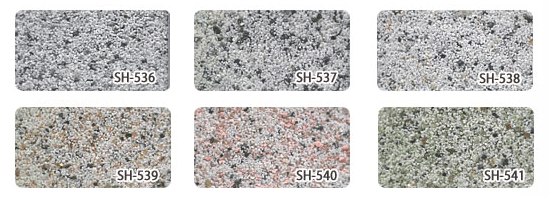
6.Lining plastering (Shine Stone)
a. The standard quantity of the material used is 5~6kg/m². Use a trowel for the work.
b. Be careful not to make the joint cover buried during the plastering work.
c. In case it is judged that the pattern has a problem, immediately stop the work, remove the problem, check the cause, and then, work.
d. In the case of inevitably stopping the lining work, be careful not to make joints.
7.Coating
a. A product using special acryl emulsion resin should be used as a coating finishing material. Use a brush, roller, or a spray to evenly apply one or two times.
b. Waterworks water should be used as a diluent and the ratio of dilution is 60~80%.
c. The standard quantity for use is 0.2~0.4kg/m², and flat is used for coating, but you can choose a glossy or semi-glossy material.
d. Evenly coat not to have different-colored gloss.
e. In the case of airless spray and roller coating, be careful not to have bubbles. |
1. The temperature for the construction work should be over 5°C and the construction place should be stayed away from rain and humidity at least for 48 hours.
2. Do not do the construction work when the relative humidity is over 80%.
3. Do not mix it with other materials.
4. Keep it in the dry, cool, and dark place in the temperature of 5°C - 30°C.
5. Repair any polluted or damaged part and do the construction work again.
6. Make it a rule to do a shine stone finishing after checking the weather condition owing to its long drying period.
7. Protect the finishing material from any pollutants floating in the air, like dust and smoke, and from weather
8. Repair any polluted or damaged part and do the construction work again. |











 Home > PRODUCTS > Finishing Materials > Exterior Use